


A pipe leak doesn’t politely announce itself at a convenient time. It hits at 11 PM on a Sunday, or mid-afternoon when you’re already juggling work and the kids. One minute everything is fine. Next, there’s water spreading across the floor, seeping into the walls, or dripping through the ceiling.
Here’s the reality: what you do in the first 10 to 15 minutes of a pipe leak emergency can be the difference between a manageable repair and thousands of dollars in water damage. You don’t need to be a plumber to handle that window of time well. You just need to know the right steps and stay calm enough to execute them.
This guide walks Tucson homeowners through exactly what to do from the moment a pipe leak is discovered to the moment the plumber walks through the door.
How to Recognize a Pipe Leak Emergency in Your Tucson Home
Signs You Have a Pipe Leak Right Now
Some pipe leaks are sneaky. They hide behind walls and under slabs for weeks before revealing themselves. Others announce themselves loudly and immediately. Knowing both types of warning signs helps you catch problems before they become disasters. Here are the most common signs Tucson homeowners should watch for:
- Unexplained spike in your water bill: If usage hasn’t changed but your bill has climbed for two or three billing cycles, a hidden leak is likely
- Water stains on ceilings or walls: Especially if the stain is growing, this points to an active leak nearby
- Warm or wet patches on floors: In Tucson’s slab-foundation homes, warm patches on tile or concrete often signal a hot water slab leak
- Musty or mildew smell: That persistent musty odor in a bathroom or laundry room? Standing water behind walls causes that
- Bubbling or peeling paint near baseboards: Paint doesn’t bubble on its own — moisture from a hidden pipe leak does that
- Hissing or dripping sounds: Sounds of running water when nothing is in use are a red flag
- Low water pressure across multiple fixtures: A sudden, whole-house pressure drop often signals a broken line somewhere in the system
When a Leak Becomes a True Emergency
Not every drip demands a 2 AM phone call. But some situations absolutely do. Call an emergency plumber in Tucson immediately if you experience:
- Visibly gushing or spraying water from a pipe
- A ceiling bulging with trapped water
- Water near your electrical panel, outlets, or appliances
- Sewage backup or sewage smell along with leak symptoms
- Complete loss of water pressure throughout the home
- A water meter that keeps spinning with everything turned off
Any of these scenarios is an emergency. Don’t wait for business hours. The faster you act, the less damage you face.
Step One: Shut Off Your Water Immediately
This is always the first move. Every single time. Before you grab your phone, before you start mopping — shut off the water. Stopping the flow is what prevents a manageable leak from turning into a full-scale flood. Even a small pipe leak can release hundreds of gallons of water if left running.
How to Find Your Main Water Shutoff Valve
Every Tucson homeowner should know exactly where their main water shutoff valve is before an emergency ever occurs. Go find it today if you don’t already know. In Tucson homes, common locations include:
- Near the water heater in a utility room or garage
- Along an exterior wall near where the main water line enters the house
- Outside in a ground-level valve box near the water meter (common for Tucson properties)
- In a crawl space or basement (less common in Tucson’s slab-foundation homes)
To shut it off, turn the valve clockwise until it won’t turn anymore. Once it’s off, open a faucet somewhere in the house to relieve remaining pressure and drain standing water from the pipes. Can’t locate the main valve? Individual shutoff valves are also located under sinks, behind toilets, and near water-using appliances.
Should You Also Turn Off Your Electricity?
Yes — if water is anywhere near your electrical panel, outlets, or wiring. Water and electricity are a deadly combination. If the leak is significant and affecting areas with electrical components, go to your breaker box and cut power to the affected rooms before you do anything else. According to the U.S. Consumer Product Safety Commission, electrical hazards from water intrusion are one of the leading causes of home fires following pipe failures.
Step Two: Locate the Source of the Leak
Once the water is off and the area is safe, your next job is finding where the leak is coming from. This matters because it tells you which temporary fix is appropriate and gives your plumber the information they need when they arrive.
What to Look For and Where to Check
Start with the obvious. Look for water actively dripping, spraying, or pooling. Common leak locations in Tucson homes include:
- Under sinks: Supply lines and drain connections are high-failure areas
- Behind toilets: The supply line connecting the wall to the toilet tank is a frequent culprit
- Near the water heater: Look for pooling water around the base and corrosion on connections
- At pipe joints: Joints and elbows are where leaks concentrate, especially in older homes
- In the ceiling or walls: Look for growing water stains, bubbling paint, or sagging drywall
- At the slab level: Tucson has a high rate of slab leaks — warm spots on the floor or the sound of running water with everything off are telltale signs
Once you’ve found the leak, plug the area loosely with rags or towels to slow the drip while you gather temporary repair materials. Place buckets under active drips to catch water and protect your floors.
Step Three: Apply a Temporary Pipe Leak Fix
This step buys you time. A temporary fix won’t permanently solve a pipe leak — only a licensed plumber can do that. But the right temporary repair can stop or dramatically slow water flow until professional help arrives.
Pipe Repair Tape
Pipe repair tape — sometimes called self-fusing or silicone tape — is one of the fastest, most accessible temporary fixes available. It bonds to itself under tension, creating a watertight seal around minor leaks and pinhole cracks:
- Shut off the water to the affected line
- Dry the pipe surface as thoroughly as possible
- Stretch the tape as you wrap it tightly around the pipe, covering the leak and extending 2 inches in each direction
- Apply 3–4 overlapping layers for a more secure seal
- Turn the water back on slowly and monitor for leaks
Best for: small pinhole leaks on straight pipe sections. Not suitable for burst pipes or major damage.
Pipe Clamps
A pipe repair clamp consists of a metal shell with a rubber pad inside that compresses over the leak point when tightened. It costs just a few dollars at any hardware store:
- Shut off the water supply
- Center the rubber pad over the leak point
- Position the clamp housing over the rubber pad
- Tighten the screws evenly on both sides until snug
- Give each screw an additional half-turn to ensure a secure seal
- Restore water slowly and check for drips
Particularly effective on copper and galvanized steel pipes.
Epoxy Putty (Plumber’s Putty)
Epoxy putty is a two-part compound that hardens after mixing, forming a rigid, watertight seal over leaks at joints and elbows:
- Shut off the water and dry the pipe thoroughly
- Knead the two parts of the epoxy putty together until the color is uniform
- Press the putty firmly over and around the leak point
- Smooth it out to fill any gaps or crevices
- Let it cure for at least 60 minutes before restoring water
- Run the water slowly and inspect the repair
Works on copper and galvanized steel — NOT recommended for PVC or PEX plastic pipes.
Rubber Pipe Connectors
If the leak is at a joint or connection point, a rubber pipe connector or flexible coupling slides over the pipe end, covering the leaking joint, and is secured with stainless steel clamps on each side. Make sure you match the connector to your pipe diameter. This method is more involved but delivers a reliable seal for joint-area leaks.
Repair Sleeves
A repair sleeve slides over a leaking section of straight pipe, providing a reinforced temporary shell over the damage. Unlike clamps, sleeves cover a longer section of pipe — making them useful for cracks that run along the pipe rather than at a single point. Simply slide the sleeve over the pipe section, center it over the damage, and secure per the manufacturer’s instructions.
Important: These Are Temporary Solutions Only
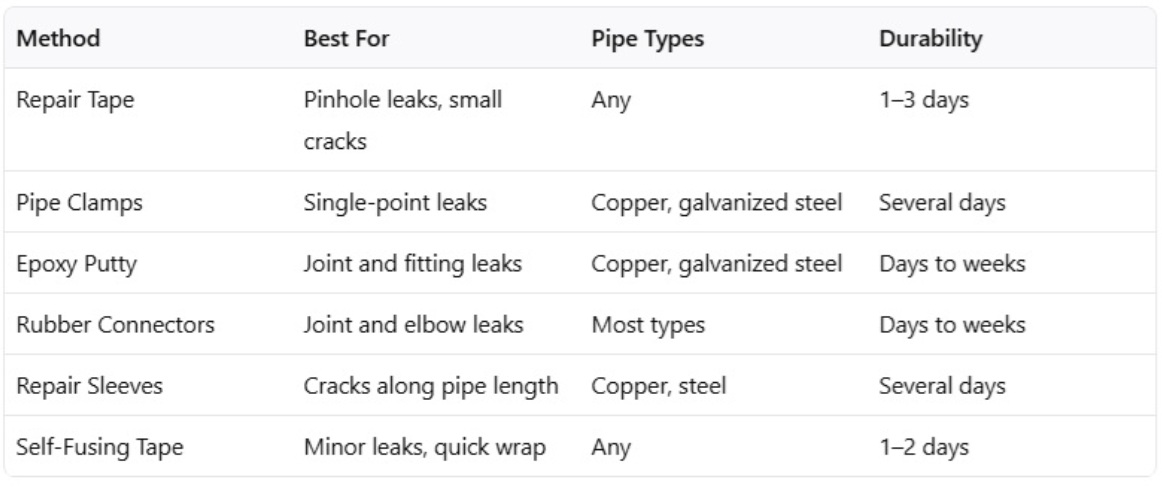
Every one of these methods buys you time — nothing more. A pipe that has failed once is compromised and will fail again. Make the call to your plumber first, then apply the patch second.
Step Four: Minimize Water Damage Before the Plumber Gets There
Water damage doesn’t wait. According to the Insurance Information Institute, the average water damage claim in the U.S. exceeds $11,000. In severe cases, costs balloon well past $20,000 when structural repairs and mold remediation are factored in. Every minute of action you take now saves money later.
Protect Your Belongings
Move fast and work systematically:
- Electronics first — TVs, computers, speakers, and devices well away from the wet zone
- Rugs and area rugs — water-soaked rugs trap moisture against floors and breed mold
- Furniture — if it can’t be moved, slide it onto towels or plastic sheeting
- Documents and valuables — financial records, passports, photos, and irreplaceable items come out first
- Clothing and linens — anything in the wet zone should be moved and dried immediately
Start Drying the Area
Mold can begin developing within 24 to 48 hours of water exposure. Here’s how to address moisture immediately:
- Use mops, towels, and buckets to remove standing water
- Open windows and doors to increase airflow
- Set up fans to direct air across wet surfaces
- Run a dehumidifier if you have one
- Peel back saturated carpet edges to allow the subfloor to dry
- Do NOT turn on HVAC to “dry things out” — this can spread moisture through your entire duct system
Step Five: Document Everything for Your Insurance Claim
Before you clean anything beyond basic safety measures, grab your phone and document. Comprehensive documentation is what stands between you and a denied insurance claim.
What to Photograph and Record
- The pipe leak or burst location — multiple angles, close and wide shots
- All standing water and affected floor areas
- Water stains on walls, ceilings, and baseboards
- Damaged belongings in place before you move them
- Any visible mold if the leak wasn’t caught immediately
- Before-and-after photos as cleanup progresses
Also create a written inventory of damaged items, including approximate value and purchase date if known. File everything with your insurance company as soon as the emergency is under control.
Step Six: Call an Emergency Plumber in Tucson Right Away
If you haven’t already called a plumber while doing the steps above, do it now. An emergency pipe leak is not a situation where you schedule an appointment for next week. Every hour of delay is more water, more mold risk, and more structural exposure.
What to Tell Your Plumber When You Call
- Your address and the easiest entry point
- The location of the leak (kitchen, bathroom, slab, ceiling, etc.)
- What type of pipe you believe it is, if you can see it
- Whether the water is still flowing or has been shut off
- Whether electricity has been shut off in the affected area
- Any visible damage — water on the floor, bulging ceiling, etc.
- Whether a temporary fix has been applied
Why 24/7 Emergency Plumbing Matters in Tucson
Tucson’s older housing stock — particularly homes built in the 1960s through 1990s — features aging copper and galvanized steel pipes that are increasingly prone to failure. Add in the region’s hard water mineral buildup, dramatic monsoon-season soil movement, and extreme summer heat, and you have a recipe for sudden plumbing failures at any hour. A 24/7 emergency plumber isn’t a luxury in Tucson — it’s a necessity.
Common Causes of Pipe Leaks and Bursts in Tucson, AZ
Tucson-Specific Factors That Stress Your Pipes
Tucson’s environment creates unique conditions that accelerate pipe wear. The combination of extremely hard water, summer temperatures hitting 100–110°F, and monsoon-season soil shifts creates stress that homeowners in other climates simply don’t face. Regular plumbing inspections — at least once every few years — are especially valuable in Tucson for catching developing problems before they become costly emergencies.
How to Prevent Pipe Leak Emergencies in the Future
- Schedule annual plumbing inspections: A licensed plumber can identify developing issues — corrosion, pressure problems, early joint failure — before they become emergencies
- Install a water pressure regulator: If your home’s water pressure exceeds 80 PSI, a regulator reduces that to a safe 60–70 PSI and protects every pipe and fixture
- Invest in a water softener: Tucson’s hard water accelerates pipe corrosion; a whole-home water softener dramatically extends the life of your plumbing
- Know where every shutoff valve is: Walk through your home now and locate the main shutoff and every individual fixture shutoff — label them if needed
- Monitor your water bill: A sudden, unexplained increase is often the first warning sign of a hidden leak
- Consider leak detection devices: Smart leak sensors placed under sinks and near appliances can alert you to water before significant damage occurs
Frequently Asked Questions About Emergency Pipe Leak Repairs in Tucson
Q: What is the first thing I should do when a pipe bursts in my Tucson home? A: Shut off the main water supply immediately. Locate your main shutoff valve — typically near your water heater, along an exterior wall, or outside at the water meter box — and turn it clockwise until fully closed. Then call an emergency plumber.
Q: Can I temporarily fix a pipe leak myself while waiting for the plumber? A: Yes, and you should. Temporary repairs like pipe clamps, repair tape, epoxy putty, or rubber connectors can slow or stop water flow until professional help arrives. These don’t replace proper pipe repair but significantly reduce damage in the meantime.
Q: How long can a temporary pipe fix last? A: Pipe tape typically holds for 1–3 days. Pipe clamps and epoxy putty can hold for several days to a few weeks. Rubber connectors and repair sleeves also offer several days of reliable sealing. None should be treated as permanent fixes.
Q: Should I call an emergency plumber at night for a pipe leak? A: Yes — if the leak is significant, don’t wait until morning. Water damage compounds rapidly overnight. Code Blue Plumbing offers 24/7 availability for exactly these situations. One call at 2 AM can save you tens of thousands of dollars.
Q: How do I find my main water shutoff valve in a Tucson home? A: In Tucson’s slab-foundation homes, the main shutoff is typically near the water heater in the garage or utility room, along an interior wall near where the water line enters the house, or outside in a valve box near the water meter. Look for a round or rectangular metal cover in your front yard or curb strip.
Q: Does homeowner’s insurance cover pipe leak damage? A: Generally yes — if the leak was sudden and accidental. Most standard policies cover sudden pipe bursts. They typically do NOT cover damage from neglect, gradual leaks that were ignored, or maintenance failures. Document everything immediately and contact your insurer as soon as the emergency is under control.
Q: How quickly can mold grow after a pipe leak? A: Mold can begin developing within 24 to 48 hours of water exposure, particularly in warm, enclosed spaces. Begin drying affected areas as fast as possible and call a water damage restoration professional if significant water intrusion occurred.
Q: What are the signs of a slab leak in a Tucson home? A: Signs include warm spots on tile or concrete floors, the sound of running water when everything is off, an unexplained spike in water bills, cracks in flooring or walls, and moisture near baseboards. Slab leaks require professional detection and specialized repair — contact a licensed Tucson plumber immediately.
Q: Can hard water cause pipe leaks in Tucson? A: Absolutely. Tucson’s water routinely measures over 200 PPM in total dissolved solids. Mineral deposits build up inside pipes over time, restrict flow, increase internal pressure, and accelerate corrosion — significantly shortening pipe lifespan. A water softener is one of the best investments a Tucson homeowner can make.
Q: How do I know if a pipe is leaking inside my wall? A: Watch for growing water stains on walls or ceilings, bubbling or peeling paint near baseboards, a persistent musty odor, or a water meter that keeps moving when all fixtures are off. Hidden wall leaks can cause significant structural damage and mold growth over weeks and months if left unchecked.
Q: How much does it cost to fix a burst pipe in Tucson? A: Simple pipe section replacements typically range from $150 to $800. More complex repairs involving slab leaks or wall access can range from $500 to $5,000 or more. Code Blue Plumbing provides free estimates with flat-rate, upfront pricing — no hidden fees.
Q: Is it safe to use water after a pipe burst? A: No — not until a licensed plumber has assessed and repaired the damage. A burst pipe can introduce contaminants into your water supply and leave the system vulnerable to further failure. Keep the water off until your plumber gives the all-clear.
Tucson’s Emergency Pipe Leak Experts: Call Code Blue Plumbing Now
A pipe leak emergency doesn’t care about your schedule. It happens fast, it spreads fast, and it costs fast if it isn’t addressed fast. That’s why Code Blue Plumbing stays available 24 hours a day, 7 days a week, for exactly these moments.
With 20 years of experience serving Tucson, Oro Valley, Marana, Vail, Sahuarita, and the surrounding communities, Code Blue Plumbing brings licensed professionals, flat-rate pricing, and genuine local expertise to every emergency call. Whether it’s a burst pipe under your slab, a blown fitting under the kitchen sink, or a mystery leak behind the wall, the Code Blue team diagnoses it, fixes it, and makes sure it stays fixed.
Don’t mop up water and hope for the best. Every minute a pipe leak runs unchecked is damage you can’t undo.